What are Soft Skills? Why Are They Crucial for Children Today?
Every parent aspires to provide the best for their children, especially in the area of education and the enhancement of academic knowledge. The goal is for children to grow up equipped with professional skills and well-rounded capabilities. These skills are classified as “Hard Skills,” which focus primarily on theoretical knowledge. However, in today’s world, hard skills alone may no longer be sufficient. This is where another crucial set of skills, known as “Soft Skills,” comes into play. Soft skills involve the development of emotional intelligence, social interaction, and interpersonal relationships — the fundamental abilities necessary for living and thriving in society.
At D-PREP International School, we recognize the importance of nurturing these essential skills in modern children. Therefore, we emphasize incorporating various soft skills into every curriculum, focusing particularly on experiential learning. Through hands-on experiences, children learn and develop both hard and soft skills simultaneously. Experiential learning encourages students to plan, solve problems, think creatively, interact, and collaborate with others. This approach fosters holistic development in all aspects, especially in cultivating critical Life Skills.
What Are Soft Skills and Why Are They Important?
Soft skills are essential abilities developed through life experiences, including emotional management, personal growth, and living harmoniously within society. They relate to various types of intelligence as follows:
Emotional Quotient (EQ)
The ability to recognize and understand one’s own and others’ emotions, express feelings appropriately, and manage emotional responses effectively. This includes self-control, optimism, patience, and empathy.Adversity Quotient (AQ)
The ability to adapt flexibly to challenges, confront problems head-on, seek solutions, accept failure, and persevere toward success.Creativity Quotient (CQ)
The ability to think imaginatively, adapt concepts creatively, and consistently seek innovative approaches.Social Quotient (SQ)
The ability to live and interact harmoniously with others, demonstrate empathy, care for the community, accept differences, and respect those from less privileged backgrounds.
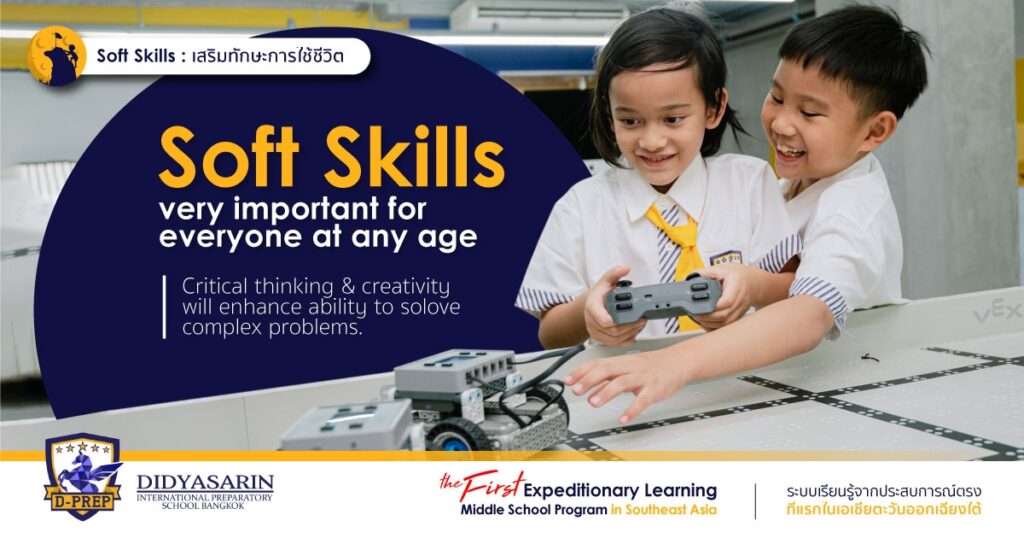
In today’s highly competitive world, professional hard skills alone are no longer sufficient. It is crucial to nurture soft skills from an early age to help children grow into well-rounded adults.
How Are Soft Skills Different from Hard Skills?
Hard skills are professional abilities acquired through practice and training, measurable through scores, certificates, or grades. Examples include learning skills, literacy, numeracy, language proficiency, cooking, technical skills, and academic expertise — typically taught in schools and applicable for future careers.
In contrast, soft skills involve emotional, social, cognitive, and adaptive capabilities, shaped through upbringing, society, and education. These should be cultivated from an early age to help children stand out, succeed, and grow into well-rounded professionals who not only possess academic knowledge but also thrive in constantly changing societies.
Today, soft skills play an increasingly important role in the hiring process. Recruiters often ask candidates, “What makes you different from others?” or “What sets you apart?” Criteria such as leadership, teamwork, resilience under pressure, creativity, and willingness to innovate are now highly valued — all of which are aspects of soft skills.
A study by the U.S. research institute Child Trends found that soft skills such as appropriate self-confidence, positive attitude, consistency, and strong social skills significantly impact employability and career success among young people aged 15–29.
(Ref: Child Trends Research)
How Does a Lack of Soft Skills Affect Children?
Soft skills can be briefly defined as “life skills.”
If they are not cultivated from a young age, a lack of soft skills may impact a child’s future life in the following ways:
Difficulty working with others
Lack of confidence and reluctance to express opinions
Fear of facing problems and giving up easily when encountering obstacles
Inability to recover from failure
Poor communication skills and difficulty adapting to social environments
Lack of creativity and imagination
What Soft Skills Are Essential for Children?
At D-PREP, we recognize the critical importance of soft skills and focus on nurturing every child through our “Life Skills” curriculum, which promotes holistic development across various competencies. The essential soft skills for children include:
1. Positive Attitude
This skill helps children build self-esteem and the belief that “I can do it.” It encourages them to maintain an open-minded outlook toward the world, view challenges as opportunities for growth, and embrace new experiences. During childhood, natural curiosity and the desire to explore are strong. Thus, parents and schools play a vital role by not restricting children’s ideas and instead encouraging them to try new things and pursue activities they love.
2. Communication Skills
The ability to speak, actively listen, and convey ideas appropriately. Strong communication skills ensure smooth collaboration with others, minimize misunderstandings, and resolve conflicts effectively. Good communicators listen openly, without bias, choose suitable language for their audience, structure their speech clearly, and use effective body language.
3. Critical Thinking Skills
The ability to think logically, hypothesize, and draw clear conclusions based on evidence. At D-PREP, our EL (Expeditionary Learning) curriculum emphasizes developing thinking processes and questioning skills through real-world experiences and direct collaboration with experts.
4. Leadership Skills
Cultivating attitudes and visions that lead teams toward success—not only in workplaces but also in everyday life situations. Participating in real-world social activities enhances leadership abilities, encourages active listening, coping under pressure, and making correct and courageous decisions.
5. Interpersonal and Social Skills
The ability to adapt socially, respect diversity, empathize with others, understand their perspectives, and avoid exploiting or oppressing those of lower social status.
6. Emotional Skills
The ability to regulate and appropriately express emotions based on the situation. Children learn to recognize their feelings and manage anger, sadness, or frustration healthily — for example, channeling anger through activities like painting or drumming instead of destructive behavior.
7. Teamwork
The ability to collaborate effectively with others toward a shared goal. At D-PREP, elementary and secondary students engage in team-based projects, collaborating with local communities and professionals to develop real-world teamwork skills.
8. Creativity and Imagination
Encouraging children to dream freely and creatively turn their ideas into reality. Creativity is key to innovation in areas such as art, technology, and new projects. D-PREP provides an environment that fully supports children’s imaginative growth.
9. Time Management
Teaching children to use their 24 hours effectively by planning, prioritizing tasks, and achieving set goals. Developing good time management habits from a young age is essential for future success.
10. Curiosity and Lifelong Learning
Fostering a sense of curiosity that leads to continuous exploration and learning. Children are encouraged to set goals and strive for personal growth, equipping them to thrive in an ever-evolving technological world.
11. Flexibility & Adaptability
The ability to manage and adjust to diverse contexts — in society, technology, daily life, and work environments. Children are encouraged to embrace new learning, shift perspectives to keep pace with changing times, face risks confidently, and adapt to new circumstances effectively.
Growing up into adulthood in today’s rapidly changing world is not easy.
Hard skills alone are no longer sufficient; a balance of both hard and soft skills is essential.
At D-PREP, we are committed to cultivating these skills through our 10 D-PREP Core Values, nurturing courage, determination, empathy, strong ethics, and flexibility.
Our collective goal is to create individuals equipped with essential life skills and the resilience to thrive happily and securely within society.
Ref
บทความแนะนำ
- Experiential learning หลักสูตรการเรียนรู้จากประสบการณ์จริงที่ D-Perp
- Design Thinking เสริมทักษะความคิดสร้างสรรค์ของเด็ก
- 10 วิธีสอนลูกและสนับสนุนให้กล้าทำตามความฝันของตัวเอง
หากท่านสนใจเข้าเยี่ยมชมโรงเรียนสามารถติดต่อได้ที่
Address :
D-PREP International School
38, 38/1-3, 39, Moo 6,
Bangna Trad Rd., Km. 8,
Bang Kaeo, Bang Phli District,
Samut Prakan, Thailand 10540
Email: info@didyasarin
Google Map: https://info.dprep.ac.th/directions
เบอร์ติดต่อ: 02-105-1757, 082-1515922
Website : www.dprep.ac.th
Facebook: DprepSchool
Line: @d-prep
IG : @dprepschool