
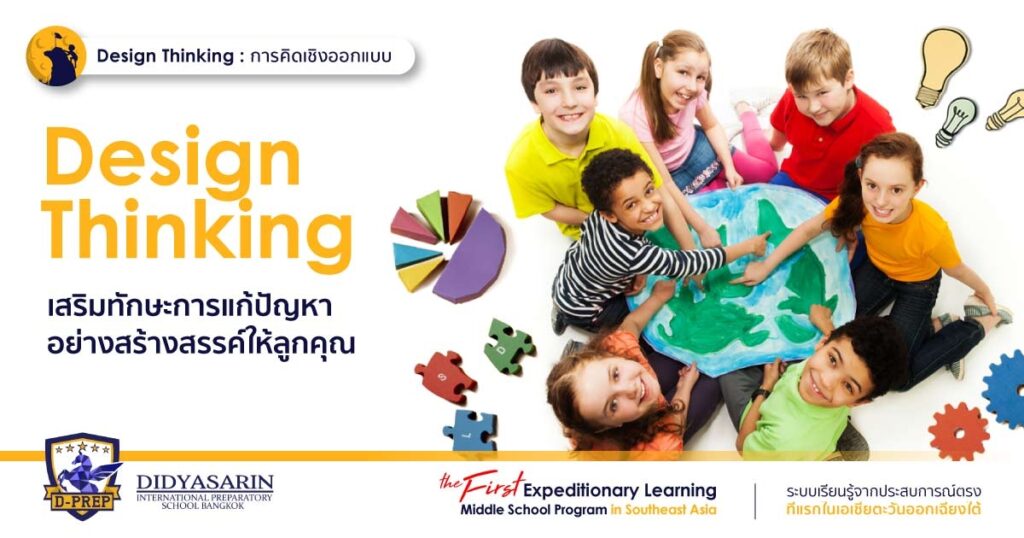
Expand Children's Imagination with the Design Thinking Curriculum
As parents, we often hear that for our children to succeed in their future careers, they will need a much broader set of skills than we did growing up. This includes the mindset of being an inventor, a problem solver, and a creator of new and exciting things for the world. As parents, how can we support and equip our children with these essential skills?
“How Can We Prepare Our Children for the Future That Lies Ahead?”
Today, there is an exciting approach called “Design Thinking” that helps build these essential skills. At D-PREP International School, we have incorporated this concept into our teaching and learning curriculum.
What is Design Thinking?
Design Thinking is widely used in the business world to foster new innovations. It is a creative problem-solving approach that applies inventive skills, focusing on “solving problems by studying real users.” This method helps researchers develop a deep empathy for users by seeing problems from their perspectives, allowing for more accurate and effective innovation. The process involves researching user needs, identifying existing problems, exploring and developing ideas, and then providing prototypes for users to test. Feedback from users is then used to refine and improve the solution.
By emphasizing problem-solving through understanding the user, Design Thinking has achieved remarkable success. Its greatest strength lies in its adaptability across various industries, especially in education. Through cultivating systematic inquiry skills in our children, we can better prepare them for a brighter future.
How Does Design Thinking Education Benefit Children?
Design Thinking helps foster and enhance essential skills in children, such as:
Developing a strong commitment to truly understanding and empathizing with users by seeing from their perspective
Strengthening the ability to analyze and creatively solve problems
Encouraging an open-minded attitude towards trying new things, embracing failure, and continually striving for improvement
Instilling ethics and respect for users
Cultivating a mindset of lifelong learning, believing that “no problem is too big to solve”
Building resilience and adaptability in the face of challenges and failures
Understanding the importance of collaboration and valuing feedback from users and peers
Boosting confidence in presenting and exploring new ideas continuously
The 5 Steps of Design Thinking
Empathise – Understanding
Researchers prioritize listening, observing, and engaging in conversations to gain a deep and genuine understanding of problems and needs, without bias or preconceived assumptions.
Define – Clearly Identify the Problem
Analyze the collected information to clearly understand and define the problem at hand.
Ideate (idea + creative) – Brainstorming
Brainstorm creative and unbiased solutions to the identified problems by collaborating with colleagues, teachers, and experts from various fields.
Prototype – Building Solutions
Develop innovations or new problem-solving approaches based on the generated ideas, and create prototypes to be tested directly by users.
Test – Validation and Improvement
Test the developed innovation with real users, gather feedback on their experiences and any issues encountered, and use these insights to make further improvements.
6 Design Thinking Processes to Empower Children's Skills with DPREP Curriculum
- Dream: Understand users’ true needs. Children choose someone they wish to help, ask questions, and record details, nurturing empathy and a true desire to solve problems.
- Define: Analyze the gathered information and clearly define the core problem.
- Discover: A fun phase where children brainstorm freely without restrictions, tapping fully into their creativity.
- Develop: Select ideas and try different materials and methods to create viable solutions. Children build creativity, problem-solving abilities, and flexibility.
- Deliver: Present the innovation or solution with pride, explaining its purpose and how it works.
- Determine: Teachers guide children through reflective questions to encourage further improvement and innovation.
By applying Design Thinking at DPREP, students gain critical Life Skill, adaptability, and the mindset to drive positive change in their communities and the world.
บทความแนะนำ

Address :
D-PREP International School
38, 38/1-3, 39, Moo 6,
Bangna Trad Rd., Km. 8,
Bang Kaeo, Bang Phli District,
Samut Prakan, Thailand 10540
Email: admissions@dprep.ac.th
Contact Number: 095-879-4944
Website : www.dprep.ac.th
Facebook: D-PREP International School
Line: @d-prep
IG : @dprepschool


